One of the things that has continued to evade my understanding in Amateur Radio is Single Sideband (SSB) transmissions, and how they can be created using anything more than just filtering out what you don’t need. New technologies use crazy math to show how to remove components from an AM signal to create the SSB signal, but it really just feels like concepts that I’ll never understand.
I’ve been using a lot of Artificial Intelligence (AI) resources recently (we’ll skip the debate on whether or not it’s actually “intelligent” for now), and have been really enjoying some of the generated responses. A coworker and I were discussing this and she mentioned Google NotebookLM as a newer resource to consider. Knowing my appreciation for podcasts, she thought this would be something I would be interested in.
I did a little test of Google NotebookLM, and I have to now wonder what other subjects of learning I can throw at this thing to help with my understanding.
Further down the page you’ll see the basic steps in creating your own content with NotebookLM, but here is the simple question and output that I received from the product for your consumption and evaluation.
My prompt:
“Explain the principles of producing SSB transmissions by using phase.”
Chosen sources:
- SSB GENERATION – THE PHASING METHOD
Explains the foundational principle of using phase to cancel sidebands. - Introduction to Weaver’s Method for SSB Signal Generation – Technical Articles
Compares the phasing method with the advanced Weaver ‘third method’. - The Phasing Method and Hilbert Transforms for Single-Sideband Modulation – Technical Articles – All About Circuits
Provides the critical mathematical background on Hilbert transforms and phasing. - Explain generation of SSB using phase shift method. – Ques10
Step-by-step operation of balanced modulators and adders in phasing circuits. - What’s The Difference Between Phase Changes And What Filtering Does? – Reddit
Social commentary explaining how phase shifts interact with combined signals. - Single Sideband (SSB) – Zimmer Web Pages
Detailed look at the Hartley modulator and quadrature phase splitters. - A Phasing Type SSB Transmitter! – n6qwradiogenius.us
Technical overview of complex polyphase networks for high-suppression designs. - Dome 1946 Wideband Phase Shift Networks.pdf – One Electron
Historical 1946 paper detailing the original wideband phase shift networks. - Analytic signal – Wikipedia
Explains analytic signals as the mathematical representation of SSB modulation. - A New Approach to Single Sideband – Generating SSSC by the “Phasing” Method – One Electron
Deep technical analysis of sideband suppression ratios and amplifier distortions.
The Output: “Slicing the Radio Signal in Half” – 33 min
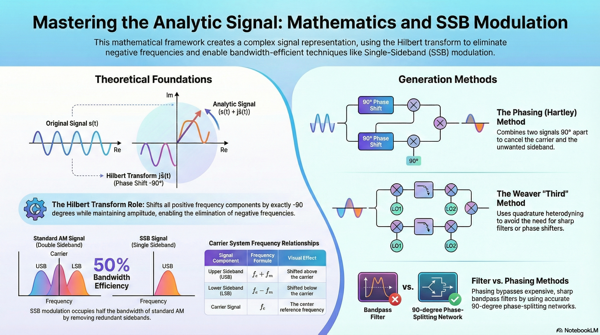
Analytic Chart Created:
My Conclusion:
This was a pretty amazing output that helped me understand a few more details regarding the subject matter. I’m no expert, but some of the analogies and breakdowns really helped me to understand key concepts in a way I haven’t been able to research and comprehend on my own.
I’m definitely going to use this resource in the future to help with other subjects that I’d like to learn about, especially if I have the time to listen to them while driving or mowing the lawn.
One thing I’m interested in, but haven’t tried yet is the “interactive” mode where YOU are a member of the podcast team, and can actually interact with the hosts. Doing this, I would be able to steer the conversation into areas where I’m unclear and need more help, or to skip subjects that I’m not interested in.
So, what do you think? Please share with me at our club meetings, nets, or send me an email to let me know your thoughts. Is this something that you could use?
73! – Cam, W4XXV
Basics of Using Google NotebookLM
We’re interested in “how antennas work”. Here are the basics to get started.
Using Google NotebookLM to create a podcast is a straightforward process that transforms static documents into a conversational audio format.
1. Gather Your Sources
The AI hosts need information to discuss. Collate high-quality materials about antennas, such as:
- Websites: Links to articles explaining electromagnetic waves or dipole antennas.
- PDFs: Research papers or textbook chapters on signal transmission.
- Videos: Public YouTube links (e.g., technical visualizers of antenna radiation patterns).
- Text: Your own notes or copied text about different types of antennas (Yagi, satellite dish, etc.).
(hint… you can ask it to find sources, then decide on whether or not you want to include them in creating the contend)
2. Set Up the Notebook
- Navigate to the NotebookLM Website and sign in with your Google account.
- Click “New Notebook” (or the plus icon) to create a fresh workspace for your antenna study.
- Upload your gathered sources. You can add up to 50 sources per notebook (or ask it to find them).
3. Generate the Podcast
- Locate the “Notebook Guide” (usually in the bottom right corner or the “Studio” panel).
- Find the Audio Overview section.
- Click “Generate”. The AI will analyze your antenna materials and create a conversational “Deep Dive” between two hosts.
4. Personalize and Refine
- Customization: Before generating, you can click “Customize” to provide specific instructions. For example, “Focus on the physics of electromagnetic induction” or “Explain antennas for a 10-year-old”.
- Format Options: Depending on your version, you may be able to choose formats like a Brief (single speaker), Critique, or Debate.
- Interactive Mode: Once generated, you can sometimes “join” the conversation to ask the AI hosts follow-up questions in real-time.
5. Listen and Share
- Wait a few minutes for the audio to process in the background.
- You can listen directly in the app, change the playback speed, or download the file as an audio file for mobile listening.
- Share the final overview with a link if you want others to learn about antennas too.
Links:
– Google NotebookLM
– Slicing the Radio Signal in Half Audio File